Tribal HUD-VASH Boot Camp Held in Oklahoma City
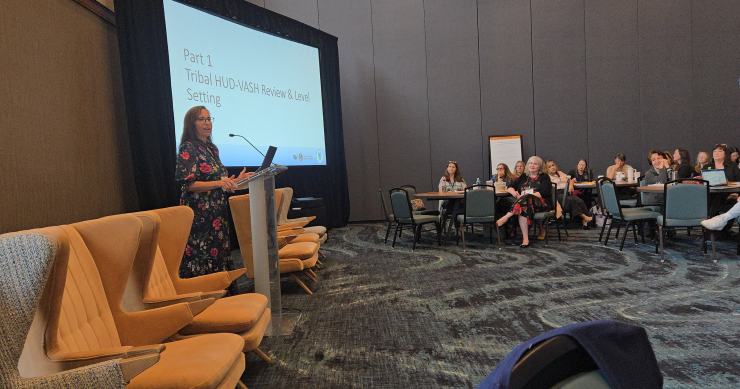
On June 9 & 10, Phil Allen, Marie Herb, Chelsea Mahoney, Kim Wilder, and Jim Yates traveled to Oklahoma City, OK for an intensive event that brought together partners from across the country, including many sovereign Native communities. Coordinated, planned, and facilitated by TAC, this U.S. Department of Housing & Urban Development – VA Supportive Housing (HUD-VASH) gathering was designed to strengthen Tribal HUD-VASH program administration, partnerships, and coordinated planning. Participants included Tribal HUD-VASH case managers, Tribally Designated Housing Entities, Department of Veterans Affairs (VA) Homeless Program Office leadership, HUD Office of Native American Programs (ONAP) leadership, and local HUD and VA field offices.
Through administrative and policy guidance, peer exchange, trauma-informed care, rural housing strategy discussions, and hands-on team planning, TAC supported participants in exploring innovative practices and developing action plans to better serve Native American Veterans experiencing or at risk of homelessness. The Boot Camp reinforced shared commitments between Tribal, HUD, and VA partners, strengthening collaboration to advance housing stability for Veterans in Tribal communities.
Sharing Successful Strategies to Combine Housing with Services that Promote Stability & Recovery
Year after year, TAC’s Priced Out data analysis (see article below) shows that there is not a single United States housing market in which a safe, decent apartment is affordable to a person with a disability who lives solely on Supplemental Security Income (SSI) and receives no rental assistance. In fact, for the 3.8 million adults with disabilities who rely on SSI, a basic apartment now costs far more than their entire monthly income. Far too many people in this situation are forced unnecessarily into costly institutional settings, homelessness, or incarceration.
State leaders across the U.S. are working to address the affordable housing crisis for people with disabilities. Limited rental subsidies and a shortage of affordable housing stock are just some of the barriers these policymakers must overcome, as people with disabilities and those with chronic, complex conditions often also need services to help them access and then maintain that housing.
TAC is hosting a webinar series that brings together state leaders, community programs, and other stakeholders to discuss successful strategies at the intersection of housing and services. There are two more webinars remaining!
- Strengthening Community Behavioral Health Services to Support Housing Tenancy
September 16, 3:00-4:00 pm EDT — Register today!
State behavioral health systems and other partners can enable community behavioral health providers to ensure housing stability. This webinar will highlight a multipronged quality improvement strategy in North Carolina designed to improve the implementation of community-based behavioral health services and related outcomes for individuals with complex behavioral health and housing needs.
- Connecting Homeless Individuals with SUD Treatment and Recovery Supports
October 21, 3:00-4:00 pm EDT — Details & registration info coming soon
Priced Out: Learn about the Housing Crisis for People with Disabilities in Your State & Community
Through its regularly updated Priced Out report, TAC shines a spotlight on the intersection of housing affordability, disability, and poverty — providing policymakers, advocates, housing planners, and service providers with critical data to drive solutions. The report underscores the urgent need for expanded affordable housing opportunities and rental assistance for people with disabilities across the country.
Use the interactive Priced Out Where You Live tool to see today’s SSI monthly payment in every state and housing market, as well as how that amount compares area median income and the average cost of a 1-bedrroom or studio apartment.
TAC In Print
TAC staff have authored two new resources published by SAMHSA’s Homeless & Housing Resource Center: The Benefits of Employment to Recovery and Economic Self-Sufficiency (Rachel Post) and Connections to Treatment and Recovery Services for Substance Use Disorders (Rebecca Boss).
Rebecca Boss also co-authored Connecting Primary Care Patients to Substance Use Treatment: Successful Referral to Treatment, published by the National Academy for State Health Policy.
Staff News
We are delighted to welcome Shawn Thiele Sacks, M.S.W., L.C.S.W., to the TAC staff as Senior Director, Behavioral Health & Medicaid! A nationally recognized behavioral health leader, Shawn specializes in strategic leadership, Medicaid program innovation, and high-impact behavioral health services for children, youth, adults, and families.
Congratulations to several staff members who have advanced to new roles at TAC: Ayana Dilday Gonzalez, M.A., Jordan Gulley, L.I.C.S.W., and Nicole LiBaire are now TAC Directors; Janice Miller, M.P.H., M.S.W., is now a Senior Consultant; and Manuela Molina Pineda is now an Associate II.
And congratulations as well to Senior Consultant Rebecca Boss, M.A., on being voted in as Board Chair for Rhode Island Communities for Addiction Recovery Efforts. RICARES serves as the statewide Recovery Community Organization, expanding the peer recovery support workforce, leading advocacy efforts for people impacted by substance use, ensuring quality recovery housing through oversight and training, and supporting the recovery community.
Opportunities to Connect
To schedule a meeting with TAC consultants at any of the events below, please email [email protected]. See you there!
- National Conference of State Housing Agencies — October 3-6
- National Association of Medicaid Directors Fall Conference— October 21-23
